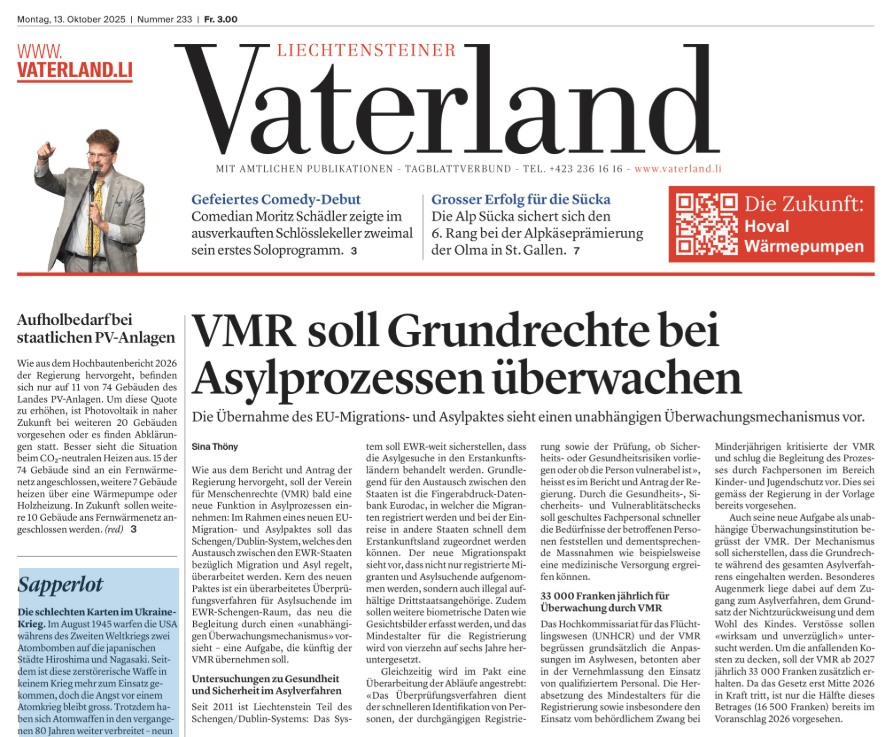
New VMR mandate starting in June under the EU Pact on Migration and Asylum
During its March session, the Landtag debated and passed the legislative amendment to implement the EU Asylum and Migration Pact (EU Pact) in its second reading (see BuA 89/2025 and BuA 16/2026).
In addition to the Aliens Act and the Asylum Act, the Act on the Association for Human Rights in Liechtenstein (VMRG) is also affected. This is because, under the EU Pact, the Association for Human Rights in Liechtenstein (VMR) assumes the mandate of the independent monitoring mechanism pursuant to Art. 10 of the Review Regulation (EU) 2024/1356. But what exactly does that mean?
The EU Migration and Asylum Pact
The EU Pact was adopted by the EU Member States in May 2024. It contains a series of new provisions on migration management and the creation of a common asylum system. It comprises a total of 10 legal acts and will enter into force in mid-June 2026. Liechtenstein is affected by those parts of the EU Pact that constitute a further development of the Schengen/Dublin acquis. These include:
- the Screening Regulation (governing the conduct of screenings in cases of irregular migration)
- the Eurodac Regulation (governing the database for Dublin cases/asylum applications)
- the Asylum and Migration Management Regulation
- and parts of the Return and Border Regulation.
Liechtenstein may also voluntarily participate in the proposed solidarity mechanism.
The independent monitoring mechanism
A new feature of the EU Pact on irregular migration is a screening procedure that determines how to proceed. This screening takes place regardless of whether an asylum application is filed.
Article 10 of the Screening Regulation provides that an independent monitoring mechanism:
- monitors compliance with fundamental and human rights during the screening process; and
- ensures that substantiated allegations related to the screening are investigated and that the progress of the investigations is monitored.
VMR Mandate
The Screening Ordinance does not specify in detail how the monitoring mechanism is to be implemented nationally, but it must be independent. For this reason, the VMR has been entrusted with this mandate in Liechtenstein. Its tasks include:
- On-site inspections within the country
- A point of contact for affected individuals
- Documentation
- Reporting and recommendations (national and international)
- National networking and exchange
- International cooperation
- Evaluation and training
The new mandate will be housed within the Migration and Social Affairs Division at the VMR.