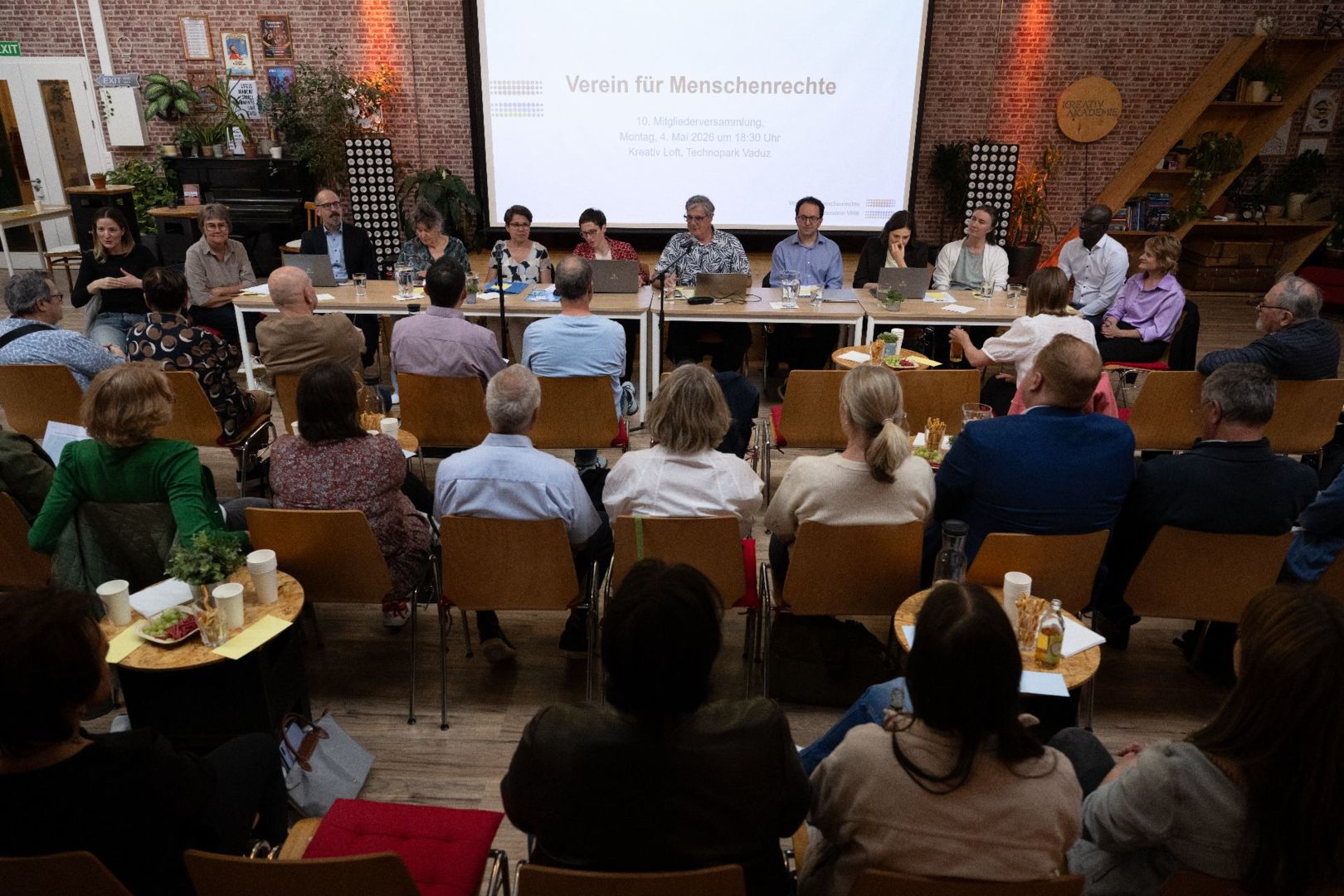
10th VMR General Meeting: A Look Back
President Wilfried Marxer welcomed attendees to the 10th General Meeting and noted that, in the ten years since the association was founded, the human rights situation worldwide has once again come under increasing pressure. Executive Director Alicia Längle announced that, for this reason, an exhibition on human rights is planned for the anniversary year 2027—the association will turn ten on December 10, 2026—at the State Museum. She aims to remind people that without human rights, there can be no stable democracy, no reliable rule of law, and likewise no thriving economy, no prosperity, and no development of personal freedoms.
Since its founding, the association has grown steadily: from 26 founding members to 117 members today—including 41 member organizations, 65 individual members, and all eleven municipalities in the state, which belong to the VMR as observer members.
The VMR’s activities have expanded significantly since its founding. Upon its establishment in 2016, the association was granted the two statutory mandates of the national human rights institution under the UN’s Paris Principles and the Ombudsman’s Office for Children and Youth. Since then, it has served as a contact and counseling center for all individuals who feel their human rights have been violated. In addition, it monitors the human rights situation in Liechtenstein, advises authorities, conducts investigations, and issues recommendations. As the Ombudsman’s Office for Children and Youth, it monitors children’s rights and advises children, youth, and all individuals who advocate for children’s rights.
In 2024, the VMR was additionally granted the mandate to review the implementation of the UN Convention on the Rights of Persons with Disabilities (MOBE). Finally, in July 2026, it will monitor the authorities’ implementation of the EU Asylum and Migration Pact. This is a new mandate that the Landtag assigned to the association this spring. The number of consultations reflects this growth: it has risen from 30 cases in the first year to 73 cases in the 2025 reporting year.
On the board, Carina Ebenhoch replaces Bernadette Kubik-Risch, who oversaw the Gender and Equality department for six years. Ms. Ebenhoch heads the Office for Women’s Services, Equality, LGBTIQ+, and Coexistence in the state capital of Bregenz and is a proven expert in the fields of equality and protection against violence. The assembly unanimously elected Ms. Ebenhoch to the board.
The assembly also approved a revision of the bylaws, which implements various recommendations from the Global Alliance of National Human Rights Institutions. The changes strengthen the association’s independence and transparency—including through term limits for board members, the exclusion of voting rights for elected officials of political parties, and the formal recognition of municipalities as institutional members without voting rights.
Following the approval of the annual report and financial statements—the 2025 financial statements show a balanced budget with total revenue of approximately 486,000 Swiss francs—the members engaged in informal discussions on shared concerns. The VMR’s annual monitoring report, which documents and comments on the human rights situation in Liechtenstein and provides recommendations for action, will be published in early June.
Since its founding, the association has grown steadily: from 26 founding members to 117 members today—including 41 member organizations, 65 individual members, and all eleven municipalities in the country, which belong to the VMR as observer members.
The VMR’s activities have expanded significantly since its founding. Upon its establishment in 2016, the association was granted the two statutory mandates of the national human rights institution under the UN Paris Principles and the Ombudsman’s Office for Children and Youth. Since then, it has served as a contact and counseling center for all individuals who feel their human rights have been violated. In addition, it monitors the human rights situation in Liechtenstein, advises authorities, conducts investigations, and issues recommendations. As the Ombudsman’s Office for Children and Youth, it monitors children’s rights and advises children, youth, and all individuals who advocate for children’s rights.
In 2024, the VMR was additionally granted the mandate to review the implementation of the UN Convention on the Rights of Persons with Disabilities (MOBE). Finally, in July 2026, it will monitor the authorities’ implementation of the EU Asylum and Migration Pact. This is a new mandate that the Landtag assigned to the association this spring. The number of consultations reflects this growth: it has risen from 30 cases in the first year to 73 cases in the 2025 reporting year.
On the board, Carina Ebenhoch replaces Bernadette Kubik-Risch, who oversaw the Gender and Equality department for six years. Ms. Ebenhoch heads the Office for Women’s Services, Equality, LGBTIQ+, and Coexistence in the state capital of Bregenz and is a proven expert in the areas of equality and protection against violence. The assembly unanimously elected Ms. Ebenhoch to the board.
The assembly also approved a revision of the bylaws, which implements various recommendations from the Global Alliance of National Human Rights Institutions. The changes strengthen the association’s independence and transparency—including through term limits for board members, the exclusion of voting rights for elected officials of political parties, and the formal recognition of municipalities as institutional members without voting rights.
Following the approval of the annual report and financial statements—the 2025 financial statements show a balanced budget with total revenue of approximately 486,000 Swiss francs—the members engaged in informal discussions on shared concerns. The VMR’s annual monitoring report, which documents and comments on the human rights situation in Liechtenstein and provides recommendations for action, will be published in early June.